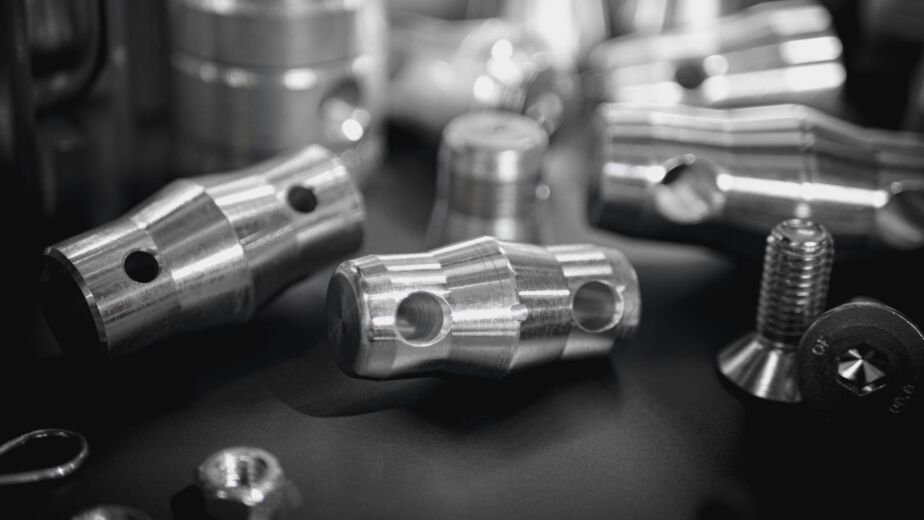
Technical Compendium: Subtractive vs. Additive Manufacturing
Modern manufacturing is defined by the strategic application of two fundamentally different physical processes: the selective removal of material (Subtractive) and the layer-by-layer deposition of material (Additive).
I. CNC Machining: The Science of Subtractive Precision
CNC (Computer Numerical Control) machining is an established high-force process where a solid block (billet) is sculpted into a final part through high-speed cutting.
1. Core Engineering Workflows
Material Removal Dynamics: Utilizing spindle speeds up to 30,000 RPM and high torque, cutting tools (end mills, drills, taps) shear material at the molecular level.
Multi-Axis Kinematics:
3-Axis: Movement along X, Y, and Z planes.
5-Axis: Simultaneous rotation on A and B axes, allowing the tool to approach the part from any angle, reducing setup changes and increasing geometric accuracy.
Coolant & Thermal Management: High-pressure flood or mist cooling is vital to maintain tool life and prevent thermal expansion of the workpiece, which could compromise micron-level tolerances.
2. Performance Metrics
Tolerances: Standard precision of ±0.025 mm, with ultra-high precision capabilities reaching ± 0.005 mm.
Surface Morphology: Achieves a “mirror-like” finish (Ra < 0.8mu) suitable for vacuum seals and high-friction interfaces.
Structural Isotropy: Parts possess uniform mechanical strength in all directions, as the internal grain structure of the original forged or rolled metal remains intact.
II. 3D Printing: The Science of Additive Synthesis
Additive Manufacturing (AM) constructs parts from the ground up, typically using lasers, electron beams, or thermal extrusion to bond raw feedstock.
1. Key Industrial Modalities
SLM/DMLS (Powder Bed Fusion): A high-energy fiber laser melts microscopic metal powder (20-60 mu). It is the only process capable of creating fully dense metal parts with internal “conformal” cooling channels.
SLA (Vat Photopolymerization): Uses UV light to cure liquid resin. It offers the highest resolution among polymers, ideal for intricate micro-features.
FDM/FFF (Material Extrusion): Melts thermoplastic filaments. While lower in resolution, it supports high-performance polymers like PEEK and ULTEM for chemical-resistant applications.
2. The Logic of “Complexity for Free”
Topology Optimization: Software can “grow” a part based on stress loads, resulting in organic, bone-like structures that are 30-50% lighter than machined equivalents.
Lattice Architectures: Internal honeycomb or triply periodic minimal surface (TPMS) structures provide extreme energy absorption and heat dissipation.
III. Head-to-Head Technical Comparison
| Technical Variable | CNC Machining | 3D Printing (Metal/Polymer) |
|---|---|---|
| Mechanical Strength | Isotropic: Uniform grain structure. | Anisotropic: Weakness typically in the Z-axis (layer lines). |
| Material Waste | Significant (up to 90% of billet). | Minimal (near-net-shape production). |
| Internal Geometry | Limited by tool “Line-of-Sight.” | Virtually unlimited (internal voids/tubes). |
| Post-Processing | Minimal (Deburring/Cleaning). | Extensive (Support removal/Heat treat/Sanding). |
| Initial Cost | High (Programming + Fixturing). | Low (Direct file-to-part). |
IV. Critical Selection Factors
1. When Subtractive (CNC) is Mandatory
High-Stress Applications: Critical drive-train components, aerospace structural ribs, and medical instruments requiring high fatigue resistance.
Specific Material Requirements: When a project requires a specific alloy (e.g., specialized Tungsten or Magnesium) not available in powder/filament form.
Mass Production: Once the “setup” is amortized, CNC is significantly faster for producing hundreds of identical units.
2. When Additive (3D) is Mandatory
Iterative Design: When the design changes weekly; AM requires zero physical tooling changes.
Lightweighting: Essential for satellite components or high-performance racing where every gram saved increases efficiency.
Consolidated Assemblies: Replacing a 20-piece bolted assembly with a single printed part to eliminate leak paths and failure points.
V. The Hybrid Paradigm
In high-end manufacturing, these processes are increasingly integrated. A common industrial workflow involves:
Additive Manufacturing to create the complex, near-net shape with optimized internal features.
CNC Finishing to “skin” functional interfaces, ensuring that bearing seats, threads, and mating flanges meet the sub-micron requirements that 3D printing cannot yet achieve.